
Home Assistant Card Editor
App 0.1.334 – visible project confirmation
The preview containing Back up and apply now sits directly below project actions, before local drafts. Opening focuses and scrolls it into view, with an explicit ready message. Loading feedback, a selection hint and a 15-second limit for read-only project requests expose failures. Writes and revision checks are unchanged. Narrow containers, DE/EN/FR, read failure, timeout and retry pass. The user confirms visible confirmation on both devices and the mobile conflict/Wi-Fi test below. Export own changes before reloading. .177 is untouched.
Passed: cross-device save conflict and Wi-Fi interruption
On 2026-10-22 the user confirms App 0.1.334 in Chrome on phone and tablet: both open the same server project. The phone saves; the stale tablet preview reports a conflict and retains draft mobil-konflikt-tablet.js. Independent server comparison confirms revision 2 with mobil-konflikt-handy.js.
The phone then loses Wi-Fi between save preview and apply. An error appears, draft mobil-konflikt-handy-offline.js remains local and the phone reconnects after Wi-Fi is restored. The server exactly retains the confirmed phone state. This tests transport loss before writing, not a controlled post-write/pre-ack loss.
Actual-device outcomes are user-reported; server states are independently compared. The owned project, guide and sidebar entry are cleaned up; seven original projects and existing data remain intact. The newest three full backups and PC evidence are retained; mobile drafts/downloads are not cleared. .177 is untouched.
From App 0.1.333, Local drafts includes a visible Search button. Enter and live filtering remain available; Clear search resets the filter. With 0 local sources, first open and safely apply a server project or import a configuration. Search only filters this browser's drafts, not server projects. Narrow 320/390/768-pixel test containers and real phone/tablet qualification pass.
Mobile qualification passed – user confirmation on 2026-10-22
The user confirms App 0.1.333 in Chrome on phone and tablet through .68: selection, Search button, tab association, portrait/landscape and separate A/B recovery work. Devices: Blackview BV6200 Pro, Android 14/DokeOS 4.0, and Samsung Tab A6, Android 11/LineageOS. Temporary server projects, guide and owned sidebar entry are cleaned up; seven original projects and existing data remain intact. .177 is untouched. Actual-device results are user-reported.
The qualified procedure on each device separately:
- Use the temporary test guide's backup button to download local draft sources. Before loading a test project, also use the normal Editor Export and retain the complete original configuration.
- Open two Editor tabs. In Shared editor projects, select A or B respectively, then Preview opening → Back up and apply. Do not overwrite the server project using Preview and save.
- Search Local drafts for
MOB68. Names, script, time and source identifiers distinguish A/B. Only the associated source says this tab. Selecting a source alone must not change the workspace. - Search for
mobil-b-68.js, then clear: the previous selection must return.MOB68 kein-treffermust show no matches and disable inspection. - Check portrait/landscape and the visible keyboard: search, list, details and buttons must remain reachable by scrolling.
- Inspect the own source and first cancel. Reload the tab, then explicitly inspect and back up/apply its preselected source. A must recover
mobil-a-68.jsand MOB68 A Sonne; B must recovermobil-b-68.jsand MOB68 B Sonne. The global workspace may initially show another state; no draft is auto-applied. - Report each device's result or exact failing step. Keep original exports and sources; close the owned test tabs or import the original configuration there.
Browser drafts are separate per device/profile and are outside HA full backups. Temporary links and projects are removed after completion. PC evidence is retained; .68 retains its three newest full backups.
Searchable draft overview – App 0.1.332
Local drafts now has its own search area, result count and source details. Search by project name, script filename, date or source identifier; multiple terms can be combined. Clear search shows all sources and restores the previous selection. Inspection is disabled when there are no matching sources.
The list shows project, localized save time, tab association and a short source identifier; details include the script filename and full identifier. Only a confirmed associated source is labelled this tab. Others show other or previous tab; existing records are not assigned invented tab names. Project is the saved card/project name. Script and source identifier distinguish identical names.
Search, selection and DE/EN/FR language changes do not alter sources. Recovery still requires explicit inspection and backed-up apply. A newer-draft recovery offer also works during a search by clearing the filter. No automatic application or deletion is introduced.
Native qualification on .68 with HA 2026.10.2 passes: duplicate project names in two tabs, project/script/source search, empty results, selection after clearing, preview cancellation, DE/EN/FR and separate recovery after reload. All 32 original sources remain byte-identical; original Editors/data are restored, fixtures cleaned and three full backups retained. .177 remains untouched. Desktop rendering is checked; Chrome's viewport override has no effect, so narrow/mobile rendering is not yet qualified.
Browser termination during repeated file import qualified – 2026-10-22
On .68 with App 0.1.331 and HA 2026.10.2, forced Chrome process termination passes after the new local draft record is written, before updating its tab pointer. Session restoration explicitly offers A's newer draft; B keeps its independent source. Cancelling the preview leaves the workspace unchanged. New A, predecessor A and B recover with unchanged content and settings; apply selects the first card. The global workspace can initially still show B: recovery remains an explicit action rather than automatic application.
All 20 previous sources in the test profile remain byte-identical. Original Editors and global configuration are restored, including after reload; owned fixture files are in trash and three full backups retained on .68. .177 is untouched. The controlled halt is between two writes; it does not qualify power loss, deleted browser storage or interruption inside the atomic Storage operation. Continue exporting browser drafts separately.
Independent tab drafts after file import – App 0.1.331
A confirmed JSON whole-configuration Import now also saves its Editor project as a separate local tab draft, even without opening a shared project first. Another file import in the same tab creates a new source and retains its predecessor. Ordinary edits then update only the new draft. Existing settings import behavior for the first import into a normal workspace is retained.
After reload, inspect the preselected Local draft and use Back up and apply. The global profile workspace can still show the last import; it does not replace the tab source requiring explicit recovery. No draft is applied automatically, and credentials are excluded from draft records. Full local or blocked session storage retains the distinct failure/export notices. Keep the source files too.
This corrects the fresh-profile finding in 0.1.330, where no tab sources were created and both tabs showed only the last import after reload. The fix concerns normal JSON whole-configuration import; it is not a new HACS qualification.
Update and native qualification on .68 with HA 2026.10.2 pass: both original failure files, reverse order, repeated identical import, own-source selection after reload and complete recoveries. Cancellation and invalid input change neither workspace nor sources. Blocked local/session writes show the correct notices; export and safe retries preserve predecessors. All 48 previous sources remain byte-identical, original Editors/global workspace are restored, fixtures cleaned and three full backups retained. New owned draft sources and PC exports remain as recovery material. .177 is untouched.
Two tabs qualified with blocked session storage and a HA outage
On .68 with App 0.1.330 and HA 2026.10.2, two different drafts remain editable and exportable with blocked session methods during a real HA restart. Both tabs reconnect automatically. Reloading while the session remains blocked never auto-applies a source: explicitly inspect and back up/apply the matching draft. Each complete recovery export matches its own outage state except export time. Only a confirmed subsequent save clears the session notice; afterwards the tab pointers remain separate across reloads. All 40 previous sources and existing data are preserved, both original Editors restored, owned fixtures cleaned and three full backups retained. .177 remains untouched. This run does not qualify Wi-Fi loss or forced browser-process termination.
Distinct local and session failure notices – App 0.1.330
Native qualification on .68 with HA 2026.10.2 passes: real full session storage with and without an existing tab pointer, blocked session methods and getter, export, manual recovery and DE/EN/FR notices. Full local storage and blocked local writes retain their distinct failure notice. All 31 previous draft sources remain byte-identical; five original Editors and existing data are restored. Owned test objects are cleaned, three full backups retained and .177 untouched. This run does not include another forced browser crash or operating-system disk-fill test.
A locally written draft survives even if its association with this tab cannot be saved reliably. Full or blocked session storage now explicitly reports “Draft saved locally” and warns that tab recovery could not be confirmed. Even a completely blocked sessionStorage getter no longer disables local draft saving.
Export before reloading or closing. Afterwards select the matching name/time under Local drafts, inspect it and use Back up and apply; do not rely on preselection. The notice survives DE/EN/FR language changes and project-list refreshes. Only another save confirming both write intent and tab pointer clears it.
A failed local record write remains a separate error with an export warning; only the previous local version is then secured. Existing sources are neither deleted nor applied automatically. If local access is completely blocked, export the current workspace and recover from the file after access returns. Full HA backups do not contain browser drafts.
This fixes the missing session warning found in 0.1.329. That earlier browser qualification preserved all 20 existing sources and data. This is not general approval of every browser or disk failure scenario.
Recover a newer draft after an interrupted save – App 0.1.329
Before writing the record, the Editor stores the intended draft in this tab's session. If saving stops after the record write but before the tab-pointer update, the next load detects the exact matching new record. It is preselected; Inspect newer draft offers the normal preview and Back up and apply flow. The current workspace stays unchanged until explicit confirmation and is backed up before applying the draft.
The confirmed predecessor, other tabs and older sources remain available. Matching does not rely on similar names or the latest global timestamp. Missing, broken or mismatched markers produce no offer. Drafts from versions before 0.1.329 and drafts without available tab session storage remain manually selectable. Detection does not replace an Export before clearing browser storage or switching devices.
Checked on .68 with HA 2026.10.2 on 2026-10-21: after the update, an owned save is interrupted precisely after its record write and before its tab pointer. Reloading shows the correct successor and offer in DE/EN/FR. Preview/cancellation leave the workspace unchanged; confirmed recovery restores all project data exactly. A newer foreign draft is not confused with it; no repeated offer appears after confirmation. This uses an owned exception at that boundary, not another forced browser-process termination or a power/disk failure test.
Independent local drafts from App 0.1.328
Shared Editor projects keep an independent local draft for each tab. After reloading, that tab's previous draft is preselected. Local drafts also lists retained versions by name and time. Inspect local draft shows the preview; Back up and apply explicitly restores it and backs up the current workspace. The selected source remains available.
The old shared draft remains readable as the "previous legacy draft". New writes do not overwrite it. Duplicated tabs also allocate fresh records when writing; a new tab does not automatically apply another tab's draft. Server revision conflicts remain blocked.
Local drafts belong to the browser profile and the particular ATLAS address. They are not included in a full HA backup. Keep a separate Export before clearing browser storage or switching devices. Local saving works during an App outage; preview and recovery require the server to be reachable again. Local record-write failures are displayed: export before reloading or closing if one occurs. Old recovery sources are not automatically deleted. Each draft permits at most 5,000 fields and 4 MiB of project data.
Checked on .68 with HA 2026.10.2 on 2026-10-21: two different drafts fully recover after tab reload and App outage; exports match except their creation time. A new tab explicitly recovers a closed tab's draft. Old sources remain selectable and server conflicts blocked. DE/EN/FR pass. Original Editors, seven server projects, six plugins and ten captured files are preserved. Owned project cleaned, three full backups on .68; .177 unchanged.
Full Chrome restart with session restoration also passes (2026-10-21, .68): The user restarts Chrome and its main process is replaced. Both restored tabs preselect their own previous draft IDs. After explicit recovery, both complete exports match their respective pre-restart versions except the export time. Other retained sources remain manually selectable. Server revision, original Editors and captured data are preserved; owned project removed and three full backups retained. .177 is untouched. This qualifies an orderly restart, not a browser crash, power failure or recovery of deleted browser storage.
Forced browser termination also passes (2026-10-21, .68): the user forcibly terminates Chrome 155. No Chrome processes remain before reopening it. After session recovery, both tabs retain their own draft IDs. The explicitly restored drafts, including their different Card titles, match the complete pre-abort exports except the export time. Four older drafts are separately exported and their project data checked unchanged afterwards. Original Editors and existing data are preserved, the owned server project removed and three full backups retained on .68; .177 untouched. Termination follows completed local saving, not an in-progress write. This does not qualify power or disk failures.
Also checked during local saving (2026-10-21, .68): an owned test probe pauses the unchanged installed Editor after writing the new record but before updating the tab pointer. The user forcibly terminates Chrome; no Chrome processes remain before reopening it. After session restoration, the confirmed predecessor stays preselected. Manually select the new complete version under Local drafts, inspect it and use Back up and apply. Its project data, including the new Card title, exactly matches the pre-test backup. Tab B and eight older sources remain unchanged. Original Editors and existing data are preserved, owned active test objects cleaned, three full backups on .68; .177 untouched. This qualifies the boundary between record and tab pointer, not interruption inside the atomic native storage call, power loss or disk failure.
Tablet result: 12/360/720-Card test on Galaxy Tab A6, Android 11 / LineageOS, Chrome Mobile 155. The user confirms 720 Cards on both hosts, including theme changes and reconnection. The user also confirms 60 minutes with UIX and 720 Cards on each host. Test objects are removed, existing data preserved and three full backups retained each.
Bounded, cancellable HACS import with App 0.1.327
The fixed ZIP limit is 32 MiB, checked before reading. Inventory budgets are 2,048 entries, 8 MiB per entry, 24 MiB total content and 1,024 UTF-8 bytes per path. Metadata budgets precede CRC work, including declared expanded sizes. Compressed entries remain unsupported; CRC32 is not an authenticity signature.
Reading and validation run in a dedicated worker. Cancel import terminates it during reading/checking and also discards an already checked result. A 15-second watchdog stops the job, subject to browser timer scheduling. Worker/load errors never fall back to synchronous import. The Editor stays unchanged until Apply checked package; final confirmed adoption is not another cancellable validation step. After cancelling, the identical file can be selected again without reload. Split larger projects into smaller packages; these budgets cannot be disabled. Cancel stays in the same position when validation completes and Apply appears.
Repeated large-project imports on .177/.68
Checked for about 25 minutes on 19 October 2026 with App 0.1.327 and HA 2026.10.2: 60 series adoptions per host, with 36 fields and 360 or 720 nested Core/Bubble/ Mushroom Cards. Across both hosts, 238 cancellations during reading/checking or after validation preserve the loaded draft; 116 identical-file retries pass. Four actual HACS round trips are byte-identical. A valid package with 24 MiB of total content completes validation. Three reload checkpoints per host pass; original Editors and captured existing data are preserved.
This qualifies import in Windows Chrome. Browser-wide process memory includes other tabs and does not establish isolated ATLAS memory stability. HA rendering was subsequently checked separately below; longer operation remains outside scope. Each confirmed import creates a local group; test groups were removed by restoring the original complete configuration.
HA rendering of 360/720 Cards on .177/.68
Checked on 19 October 2026 with unchanged App 0.1.327 and HA 2026.10.2: original exported projects and owned dynamic copies with Core, Bubble 3.4.2 and Mushroom 5.2.3. Card-Mod 4.2.1 and UIX 8.4.0 run separately. UIX handles both card_mod and native uix styles. 62 settled snapshots pass 33,120 comparisons against native reference Cards, with no error Card: light/dark, CSS inheritance, borders/radii and Bubble opacity. Mushroom Jinja changes text, icon and color with owned states 18/28. Eight WebSocket closures reconnect automatically without page reload; HA may rebuild its Card view during recovery.
Full backups precede testing; existing Editors are neither opened nor modified. Captured files, seven projects and six plugins per host are preserved. Owned test setup is removed and WWW files moved to Trash. Windows Chrome is the tested browser; FPS, tablet/ARM64-browser performance, leak freedom and long-term use are not established. Measurements follow completed theme transitions and module loading, rather than intermediate states.
Historical size finding with App 0.1.324
Checked on 19 October 2026 with App 0.1.324 and HA 2026.10.2 on .177/.68: 24 actual imports, including 16 valid adoptions at 112/112 and eight rejections. Up to 30,008 files, 64 MiB of extra stored content and a 16-MiB README are accepted. Deflate archives with 128 MiB of content or an almost 4-GiB declared entry size, and truncated ZIPs, are rejected. Compression rejection is not a size limit or a claim of zip-bomb protection.
Explicit byte/file-count limits and reliable cancellation of an active import were missing in 0.1.324; the worker flow above now applies. That old implementation reads the complete file before synchronous UI-thread validation. Reload immediately after file selection preserves the original draft in one attempt per host, but does not prove cancellation during CRC work. Both complete original Editors and checked existing data are preserved. Testing uses Windows Chrome, not a browser running on the Pi.
Safe HACS package adoption from App 0.1.324
Multiple embedded ATLAS projects or scripts are rejected before package selection. HACS, package and Editor plan script filenames must agree; resource filenames, custom element and Card types are cross-checked. Legacy resource prefixes remain valid when they identify the same script file. Both the Reader and actual Editor handler require fully approved readiness. A blocked or incomplete report cannot overwrite the Editor. Valid JSON/YAML, root/dist layouts and single-word filenames such as temperature.js remain supported. All 418 package tests, including 40 new shipped-handler regressions, pass. Existing stored data is not migrated or rewritten.
Updates on .177/.68 with HA 2026.10.2 pass after fresh full backups: 60 actual imports, 52 correct rejections and eight valid controls at 112/112. All 14 earlier incorrect adoptions are blocked. After every case, reload and complete original Editor exports match the backups; checked existing data, seven projects and six plugins per host remain intact.
Historical finding: ambiguous HACS packages through App 0.1.323
Native qualification on .177/.68 with HA 2026.10.2 finds 14 incorrect adoptions among 46 imports. Six packages per host with multiple projects or extra scripts are adopted despite a blocked report at 111/112. With same-identity projects, ZIP entry order selects the content. A conflicting script name in the Editor plan is even accepted at 112/112 on each host and copied into the Editor. These cases are fixed from 0.1.324.
Exact duplicate paths, root/dist aliases and direct HACS/script mismatches are correctly rejected: 26 rejections total; six valid controls remain importable. CRC checks and accurate ZIP failure diagnostics remain intact. A blocked report alone currently does not protect the Editor from these ambiguities. Use only unambiguous exports; restore an overwritten draft from its original or backup. Tests restore complete original Editors after every case and preserve checked existing data. That earlier qualification kept ATLAS at 0.1.323.
Accurate ZIP failure diagnostics from App 0.1.323
CRC, header and ZIP readability errors make ZIP verification the first blocker. A discarded inventory no longer produces invented missing-file claims. Dependent file/content checks remain explicitly unverified until an intact archive is available. Import stays blocked and the Editor state is unchanged. Actually missing files in verified ZIPs still produce errors. The stable list retains 112 checks; all 378 package tests, including 54 integrity cases, pass.
Updates on .177/.68 with HA 2026.10.2 pass after fresh full backups: 60 rejections and four valid JSON/YAML controls succeed. All 26 cases with unavailable ZIP inventories show the ZIP cause first without invented missing-file claims. Actually missing files remain detectable. Complete Editor configurations match their backups after rejection/reload and after restoring valid import controls. Checked existing data, seven projects and six plugins per host remain unchanged.
ZIP integrity checks from App 0.1.322
Before HACS adoption, ATLAS validates every stored ZIP entry's CRC32, including README, locales and extra files. Local and central headers must agree on names, flags, method, CRC and sizes; directory bounds, counts and overlapping entries are checked. Corrupted archives expose no importable package data to the Editor. All 52 new integrity cases and 376 package tests pass. Valid original archives remain byte-identical, preserving empty names and outer whitespace. Native updates from 0.1.321 to 0.1.322 pass on .177/.68 with HA 2026.10.2 after full backups: 30 corrupt/invalid packages per host are rejected and two valid JSON/YAML originals each pass at 112/112. After each rejection and reload, the complete Editor configuration stays unchanged. The original CRC failure is rejected. Original Editors and existing data, including seven projects and six plugins per host, remain intact.
Import supports stored ZIP entries (STORE). Compressed entries, encryption, data descriptors, multi-disk and ZIP64 are rejected. Normal ZIP comments remain valid. CRC32 detects corruption; it does not authenticate a package or its source. In 0.1.322, discarded inventories could produce misleading missing-file notices after CRC failures. From 0.1.323, these dependent checks are marked unverified.
Historical CRC finding through App 0.1.321
After fresh full backups, 21 actual Editor imports per host are checked on .177/.68 with HA 2026.10.2. Missing, empty, whitespace-only or conflicting names in HACS/package manifests, seven missing required files including declared locales, unreadable/truncated ZIPs and broken manifest/package JSON are correctly rejected in 19 cases per host. After each rejection and reload, the complete Editor configuration is unchanged except its export timestamp. The valid control package passes at 112/112 on both hosts.
A ZIP with modified README bytes and an invalid stored CRC is nevertheless accepted at 112/112 on both hosts and replaces the local Editor state. An independent ZIP reader confirms the CRC error. Readiness in 0.1.321 did not prove complete ZIP integrity. CRC validation is corrected from 0.1.322 and confirmed on .177/.68; regenerate damaged packages from an intact original. Both original Editors were restored exactly from backups; existing files, projects, plugins and trash remain intact.
HACS title checks from App 0.1.321
Both title-presence checks now use the same package identity as manifest/script consistency checks. An empty or whitespace-only first Entity name no longer causes a false title failure. Original names and archives stay unchanged. All 324 local package tests pass, including 28 new JSON/YAML, standalone, stack, Conditional and invalid-manifest checks. The four saved failing ZIPs and four control packages pass unchanged at 112/112 and reexport byte-identically. Missing or mismatched manifest names remain rejected. Native updates from 0.1.320 to 0.1.321 pass on .177/.68 with HA 2026.10.2 after fresh full backups. The four original failing JSON/YAML ZIPs without a control card each reach 112/112 in the actual Editor and reexport byte-identically. All eight cards retain exact names and Conditional conditions after import and reload. Existing data, seven projects and six plugins per host, and both original local Editors remain intact. This check supplements the earlier HA rendering comparison; it creates no new HA resources or dashboards.
Literal Entity names from App 0.1.320
Explicit Entity names remain unchanged during import: name: '', whitespace-only names and outer spaces/tabs. Only a missing name retains the previous fallback. All 296 local package tests pass, including 37 new checks against the unparsed original source, JSON/YAML, nested Conditionals, draft restoration, Card packages and HACS. Deliberate renaming and entity selection remain available. Stored data is not rewritten; recover previously normalized names from the original or backup. Native updates from 0.1.319 to 0.1.320 pass on .177/.68 with HA 2026.10.2 after full backups: 64 JSON/YAML file/paste cases with 128 captured outputs after import and reload, plus 16 actual Card package roundtrips, retain original values exactly, including nested Conditionals. Existing data and both original local Editors remain unchanged. The subsequent native HACS check on both hosts passes with a named control card before the eight name cases: four JSON/YAML ZIP roundtrips, 112/112 checks each and byte-identical reexports. Seventy-two exported/native HA pairs match before and after reload (144 rendered card samples). DOM text retains outer spaces/tabs; normal HA CSS visually collapses them, matching native cards. Scripts and locales are loaded unchanged from the actual ZIPs; no new HACS repository installation is included.
HACS readiness gap through App 0.1.320
When the package starts with an empty Entity name, readiness reports 110/112: package-title-present and import-summary-title-present fail despite a named package. A whitespace-only first name also fails the title check. Name data stays intact, but readiness is unreliable here. A named control card before the same eight cases passes. The title check is fixed from 0.1.321 and confirmed natively on .177/.68 with the original ZIPs. The native empty-string failure on 0.1.320 is reproduced; the whitespace case follows from trim() in the check implementation.
Standalone Card correction from App 0.1.319
Conditional cards become complete Expert fields with their conditions and nested cards intact. Standalone Entity cards retain their custom names; explicit renaming and entity selection still work. All 259 local package tests pass, including 19 new checks of the actual Editor conversion, draft restoration and JSON/YAML/HACS export. Stored data is unchanged. Recover previously lost content by reimporting its original source or backup. Native updates on .177/.68 pass with HA 2026.10.2 after full backups: 32 cases retain original structure through JSON/YAML file/paste imports and reload. Eight actual Card packages pass export, reimport and reload. Existing data and both original local Editor configurations remain unchanged.
Boundary through App 0.1.319
The parser still replaces name: '' with Imported entity card and trims outer whitespace from Entity names. Sixteen additional controls confirm this behavior on both hosts; they do not prove literal source-name preservation. Earlier local tests compared values only after normalization. Normal custom names and Conditional conditions pass on 0.1.319, correcting the corresponding 0.1.318 losses. This increment includes no new native HACS ZIP or HA rendering test.
Import preview from App 0.1.318
Preview now uses the actual import parser, including nested cards and package/ export payload contents. Unsupported Markdown cards are rejected before the Editor state changes; Markdown support is not added. Supported standalone Entity and Conditional cards are also recognized as JSON, and YAML is checked structurally. All 240 local package tests pass, including 27 new parity tests. Native updates on .177/.68 pass after full backups:24 Markdown rejections through file/paste import retain Editor code, and eight nested JSON/YAML imports preserve structure. Existing data and original local Editors are preserved, including after reload. The earlier standalone losses pass retesting on 0.1.319; name normalization is fixed from 0.1.320 and passes native qualification on .177/.68.
Extended Conditional rendering checked on 2026-10-18
With ATLAS 0.1.317 and HA 2026.10.2, native references and scripts exported from JSON and YAML agree in 1,008 visibility decisions: 14 variants, six state cases and browser widths of 898 and 2560 CSS pixels on the two approved test systems. Coverage includes implicit AND, nested AND/OR/NOT, state/state_not lists, entity_id, strict numeric bounds including zero and entity references, screen/user conditions and nested Conditional cards. Saving and reopening retain JSON and YAML exactly. User checks cover the actual signed-in user and an excluded test ID. Both formats also pass actual HACS reimport on both hosts: 112/112 package checks each and byte-identical re-export. Original local Editors and captured existing data are preserved; owned test artifacts are cleaned up and test files remain recoverable in trash. This does not qualify every card or condition type: this matrix uses Core Entity leaves. An actual import rejected a Markdown leaf even though its preview reported it as importable. New network tests are restricted to 192.168.178.177 and 192.168.178.68; earlier reports involving other hosts are historical evidence.
Report a problem (since 0.1.287)
Report a problem first creates a local preview. Copy report copies the reviewed text; if clipboard access fails, the preview remains available for manual copying. The GitHub button opens only the issue form with instructions. The report is neither sent automatically nor embedded in the GitHub URL.
The filter removes credentials from structured fields, quoted JSON/YAML, URL userinfo and token fragments, and removes the known HA session token from other report text. Cookies and browser storage are not read; configured-key flags contain only booleans. Still review card text, entities and personal information before sharing. Opening the report does not change projects, settings or plugins.
The ATLAS Home Assistant Card Editor is the first visible reference application in the ATLAS environment. It is used to design Home Assistant cards visually, import existing YAML cards and prepare exportable card packages or HACS-oriented bundles.
Since HA app 0.1.286, reload and JSON/HACS import preserve template IDs and resize reference dimensions. HACS bundles can be reimported when the project name differs from the first card title: the two package manifest names are compared. Card contents and existing settings remain intact.
The Administration → Plugin Hub → HA connection → Expert editor → export/import workflow was verified in DE/EN/FR using a mock HA endpoint, an isolated browser profile and a test plugin, including reload and container restart. This does not replace verification against a live Home Assistant installation. Additional native checks on Pi 5 and Proxmox are now complete; scope and remaining limits are recorded in Development Status.
The local demo uses:
http://127.0.0.1:4174/Connection settings are managed through Atlas Administration:
http://127.0.0.1:4175/Expert Workflow
The editor now opens directly in the Expert workflow. The former visible Simple mode and the Simple/Expert switch have been removed. Import, HA card import, YAML paste, resource debug and entity selection remain available as tools.
Cards are placed from the left card list onto a Home-Assistant-like grid surface. They can be moved, edited, nested and exported as Home Assistant YAML.
Home Assistant Connection
The Card Editor can receive a Home Assistant URL and access token from Atlas Administration. The token is not written permanently into the editor; it is only used as a session handoff.
The editor currently supports:
- connection through the Home Assistant WebSocket API
- loading entities through
get_states - local cache for entities and entity domains
- synchronization status below the connection state
- search and filtering by domain, name or entity ID
- Lovelace resource checks through the browser WebSocket and Admin WebSocket proxy
The resource debug panel can be enabled through Show resource debug. It shows whether the browser WebSocket, the Admin WebSocket proxy or a fallback is stuck.
Card List
The Expert card list contains Core cards and detected Community cards. It can show local templates, known HACS resources and scan-only resources.
Supported base cards include:
- Entity
- Entities
- Overview / Glance
- Button
- Grid
- Sensor
- Vertical stack
- Horizontal stack
- Thermostat
- Link
- Webpage
- Mushroom Template
- Bubble Card
- Tabbed Card V2
Scan-only entries are registered Lovelace resources for which ATLAS does not yet include a built-in card mapping. They can be mapped locally to the matching custom:* Lovelace card type. After that mapping, they become active custom cards in the palette, can be placed through drag and drop and keep their resource path when resource snippets are exported. Palette entries that are not useful as cards, such as JavaScript helper resources, can be marked as hidden locally. Hidden cards disappear from the normal list, remain visible in the full list and can be restored from there. The import tools also include an opt-in automatic card type mapping option. It tries to derive a custom:* card type for unknown registered resources from the JavaScript filename and therefore carries a red safety warning.
Container Cards
Expert mode supports container cards for:
vertical-stackhorizontal-stackcustom:tabbed-card-v2
Cards can be placed into these containers through drag and drop. Tabbed Card V2 manages tabs and the cards contained in each tab. Stack cards keep their contained cards as separate elements and show them as a text list in the info box.
Import
The editor can import Home Assistant card configurations from:
- YAML files
- YAML from the clipboard
- JSON
- ATLAS Card Packages
- HACS bundles with embedded
atlas/*.atlas-card.json
During import, ATLAS detects card_mod and uix styles. Entity styles are assigned to the matching entities; global styles remain visible as their own style block. The original YAML should stay as close as possible to the imported source and only change when the user edits the card.
Hand-written custom:tabbed-card-v2 cards with tabs[].card, nested horizontal-stack/vertical-stack sections and raw custom cards are detected and opened directly in Expert mode as a container structure.
Export
The editor can create several artifact types:
- Home Assistant YAML
- Expert HA card YAML
- Card script
- Card package
- HACS-oriented bundle
- resource list
When exporting an HA card, users can choose whether styles are written as card_mod or uix. Export filenames receive a Windows-style counter when a name already exists.
Verified HACS bundle round trip
App 0.1.307 qualifies a mixed Core/Bubble/Mushroom project with isolated HA Core 2026.10.1: ZIP import, actual browser download, reimport and re-export preserve fields, grid metadata and card configuration. The re-exported ZIP is byte-identical in this test. Bundle checks compare the project name with the verified package name; distinct child-card names no longer cause false conflicts.
The exported script renders in real HA with Bubble 3.4.2 and Mushroom 5.2.3, including live state changes. HA uses generated stacks; preserved grid metadata does not guarantee identical pixel geometry. The isolated resources were served through /local/; this does not qualify HACS repository downloads.
Language files in the exported script
From App 0.1.308, generated Card scripts load locales/en.json and the selected language relative to their own script URL. Deploy JavaScript and its sibling locales/ folder together on the same HA origin; register the Lovelace resource as type module. Cards follow the HA language. Override it with language: de or language: fr in the Card configuration; regional values such as de-DE and fr-FR use their base language.
The title, demo-entity hint and script-owned error message use the locale file. Missing, invalid or partial translations fall back per field to en.json, then embedded EN. The script also works without language files. A distinct explicit title or replacement_hint takes priority. Authored field names and entity IDs remain unchanged; HA translates HA/community labels. Each language loads once per page visit. Reload after editing files; after script updates, use a new version query on the resource URL if necessary.
EN/DE/FR exports are independent of the editor language. Without an executed translation adapter, DE/FR contain marked English fallbacks requiring translation and review.
Combined HACS delivery from 0.1.309
The export ZIP contains root hacs.json, with script and languages under dist/, for example dist/energy-kitchen.js and dist/locales/en.json. Extract the complete ZIP into a dedicated GitHub repository named energy-kitchen and add it to HACS as a Dashboard repository. Match the repository name to the script filename without .js; use a separate repository from the ATLAS integration.
HACS installs dist/ contents into www/community/energy-kitchen/. The module resource is /hacsfiles/energy-kitchen/energy-kitchen.js, with JSON files in its sibling locales/ folder. HACS registers the module in storage mode; in YAML mode, add the resource documented in the bundle yourself.
Do not also place the script at repository root or attach a standalone JavaScript release asset: HACS can prefer it over dist/. The export ZIP is not a zip_release installation asset. HACS 2.0.5 can omit language files when the script filename begins with dist; ATLAS blocks that export with a message. Choose another HACS script filename. Existing projects remain intact.
The real GitHub/HACS flow is also verified in isolated HA 2026.10.1 with HACS 2.0.5: user-approved GitHub device authorization, custom Dashboard repository registration and download from main. The script and EN/DE/FR install with exact GitHub bytes; HACS registers the module automatically. Legacy ATLAS bundles remain importable.
The public Card export repository is explicitly a test example. In the HACS main menu, open Custom repositories, enter that GitHub address, select Dashboard and choose Add. Open Locale test card, confirm Download, then reload the browser. Its resource is /hacsfiles/atlas-hacs-delivery-card/atlas-hacs-delivery-card.js. In v0.1.0, DE/FR are marked English fallbacks. v0.1.1 contains manually translated test strings: “Wohnzimmer 0.1.1” and “Salon 0.1.1”. This does not demonstrate automatic translation. Bubble Card and Mushroom are additionally required for its mixed example Card.
The tagged cycle v0.1.0 → v0.1.1 → v0.1.0 is also verified in isolated HA 2026.10.1/HACS 2.0.5. Save a full backup first. In the repository menu, choose Update information. HACS detects the new version as a pending update; use Redownload to install the offered version, then reload the browser. For the verified manual reinstallation of the old version, open Redownload, expand Need a different version?, choose v0.1.0 under Release, download and reload again. HACS explicitly recommends restoring a backup rather than using this version selector to roll back. Reinstallation replaces Card files; it does not restore migrated data from a backup.
Both releases use dist/ without a standalone JavaScript release asset. The script and all three locale files match the selected tag exactly after each step. The module resource retains its ID; HACS changes its hacstag. Other resources, settings, projects and dependencies remain intact. The old version also works after restarting the test system. HACS still offers v0.1.1 as an update afterwards; selecting the old version does not permanently pin it.
This is custom registration, not inclusion in the central HACS default list. Pi 5 and Proxmox were unchanged.
Failed and interrupted updates
From ATLAS 0.1.310, newly generated Card scripts check EN and all languages selected for export, including inactive languages. Missing, unreadable or invalid JSON files with mismatched language metadata produce a compact notice listing the affected paths. Its EN/DE/FR repair text is embedded independently of those files. Cards and live states remain usable with the existing language fallback.
In HACS, redownload the complete Card package and reload the browser; restore your backup if needed. The notice disappears after successful repair and reload. Existing installed scripts need re-exporting and redistribution. This detects missing/unreadable files.
From 0.1.311, newly exported scripts and locales also share a deterministic package marker (_meta.packageId in locale files). A different or missing marker also triggers the repair notice; affected text is ignored, retaining EN or embedded English fallback. Keep the marker when translating. Do not copy markers between packages to suppress warnings. This detects accidental mixed exports, not tampering or text changes retaining the marker; it is not a signature. Identical exports have the same marker. Old scripts are not retroactively changed. There is no automatic repair or recovery. The new package check is first verified in isolated HA 2026.10.1/HACS 2.0.5: mixed EN/FR, missing markers, continued Card rendering and repair after reload. Pi 5 and Proxmox remained at 0.1.310 during that isolated qualification.
The App update and package check are subsequently tested on both hosts with 0.1.311: own /local/ Cards, mixed EN/FR, missing FR marker and repair after reload. Existing settings, projects and checked files remain intact. Separate historical finding: File Studio trash lived in the replaceable App container. Only our previous test folders existed there; they were reconstructed from PC copies with original metadata. App 0.1.312 corrects storage, with isolated container replacement and backup recovery verified. Before the first update, copy the legacy stores inside the old container and back up the prepared data; see File Studio. Subsequent native legacy adoption and the 0.1.312 upgrade also pass on Pi 5 and Proxmox with data preserved. This is not another native HACS repository installation test.
The 0.1.310 update and this check are also tested on Proxmox and Pi 5 after fresh backups: separate newly generated test Cards, missing FR and EN, then restoration after reload, with settings, projects and external plugins preserved. Native verification uses separate /local/ test resources, not another GitHub/HACS installation. Temporary read failures can also trigger the notice; an initial preview notice on Proxmox cleared after a fresh reload. A notice alone does not prove permanent file corruption.
Failures were injected into a dedicated isolated HA 2026.10.1/HACS 2.0.5 clone: the new script was really downloaded from GitHub and written, then locale downloads reported failure or the process was killed before they completed. Only this HACS test clone contained the test instrumentation.
On a reported download error, HACS shows an error and automatically restores the old Card including EN/DE/FR. A hard process interruption instead leaves the new script with missing locale files, even after restart. HACS can still show the old installed version. Embedded EN fallback can keep the Card visible; rendering and the version label alone do not prove a complete installation.
After removing the fault, Redownload with the known old release was verified successfully. Reload the browser afterwards and check the script, every locale file, resource registration and rendering. A separate full Docker HA configuration snapshot was also restored into a new empty test volume: all 2,500 saved files matched before startup; HACS, Cards and live states worked again afterwards. Settings, dashboard and dependencies remained intact.
The temporary HACS backup does not replace your own backup. Automatic repair after process interruption is not guaranteed. This is a controlled fault test and Docker volume restoration, not proof for every network/storage failure, HAOS backup restoration or other HACS versions.
Tabbed Card V2
Tabbed Card V2 is handled as its own ATLAS card and exports as:
type: custom:tabbed-card-v2Expected resource:
/hacsfiles/tabbed-card-v2/tabbed-card-v2.jsExport prerequisite: ATLAS Tabbed Card V2 must be installed in Home Assistant. It belongs to the ATLAS plugin/card line and is provided through the ATLAS repository:
https://github.com/rockbaer2007/atlas
The editor notes that Tabbed Card V2 is its own card. It is inspired by the original kinghat/tabbed-card, but maintained as a separate ATLAS variant.
The built-in Home Assistant editor for the card accepts YAML or JSON directly. Multi-line YAML blocks such as >- and |- stay multi-line values, so Mushroom template chips, Jinja expressions and card_mod styles are not destroyed when the code is applied.
Opacity values for active and inactive tab backgrounds are rendered as stable color values before switching tab content. This keeps transparent tab backgrounds consistent after moving between tabs.
Tabbed Card V2 Styling
Tabbed Card V2 keeps the Material tab variables and adds dedicated variables for tab backgrounds, radii and spacing:
| Name | Default | Description |
|---|---|---|
--mdc-theme-primary | --primary-color | Active tab text, indicator and accent color. |
--mdc-tab-text-label-color-default | --secondary-text-color | Inactive tab text color. Use an rgba(...) value with alpha when transparency is needed. |
--mdc-typography-button-font-size | 14px | Tab label font size. |
--tabbed-card-v2-card-background | Home Assistant card background | Background of the outer card. Use transparent for a glass/overlay layout. |
--tabbed-card-v2-card-border | Home Assistant card border | Border of the outer card. |
--tabbed-card-v2-card-border-radius | Home Assistant card radius | Border radius of the outer card. |
--tabbed-card-v2-content-padding-side | 0 | Equal left and right spacing inside the card content area. |
--tabbed-card-v2-content-padding-bottom | 0 | Bottom spacing inside the card content area. |
--tabbed-card-v2-tabbar-background | transparent | Background of the whole tab bar. |
--tabbed-card-v2-active-background | transparent | Background of the active tab. |
--tabbed-card-v2-active-background-opacity | 100 | Active tab background opacity from 0 to 100. |
--tabbed-card-v2-inactive-background | transparent | Background of inactive tabs. |
--tabbed-card-v2-inactive-background-opacity | 100 | Inactive tab background opacity from 0 to 100. |
--tabbed-card-v2-hover-background | --secondary-background-color | Background while hovering or focusing a tab. |
--tabbed-card-v2-tab-border-radius-top | 0 | Top-left and top-right radius for each tab. |
--tabbed-card-v2-tab-border-radius-bottom | 0 | Bottom-left and bottom-right radius for each tab. |
--tabbed-card-v2-tabs-padding-left | 0 | Space before the first tab. |
--tabbed-card-v2-tabs-padding-top | 0 | Space above the tab row. |
--tabbed-card-v2-tabs-gap | 0 | Space between tabs. |
--tabbed-card-v2-indicator-inset | 0 | Horizontal inset for the active tab indicator. |
--tabbed-card-v2-indicator-border-radius | 0 | Border radius for the active tab indicator. |
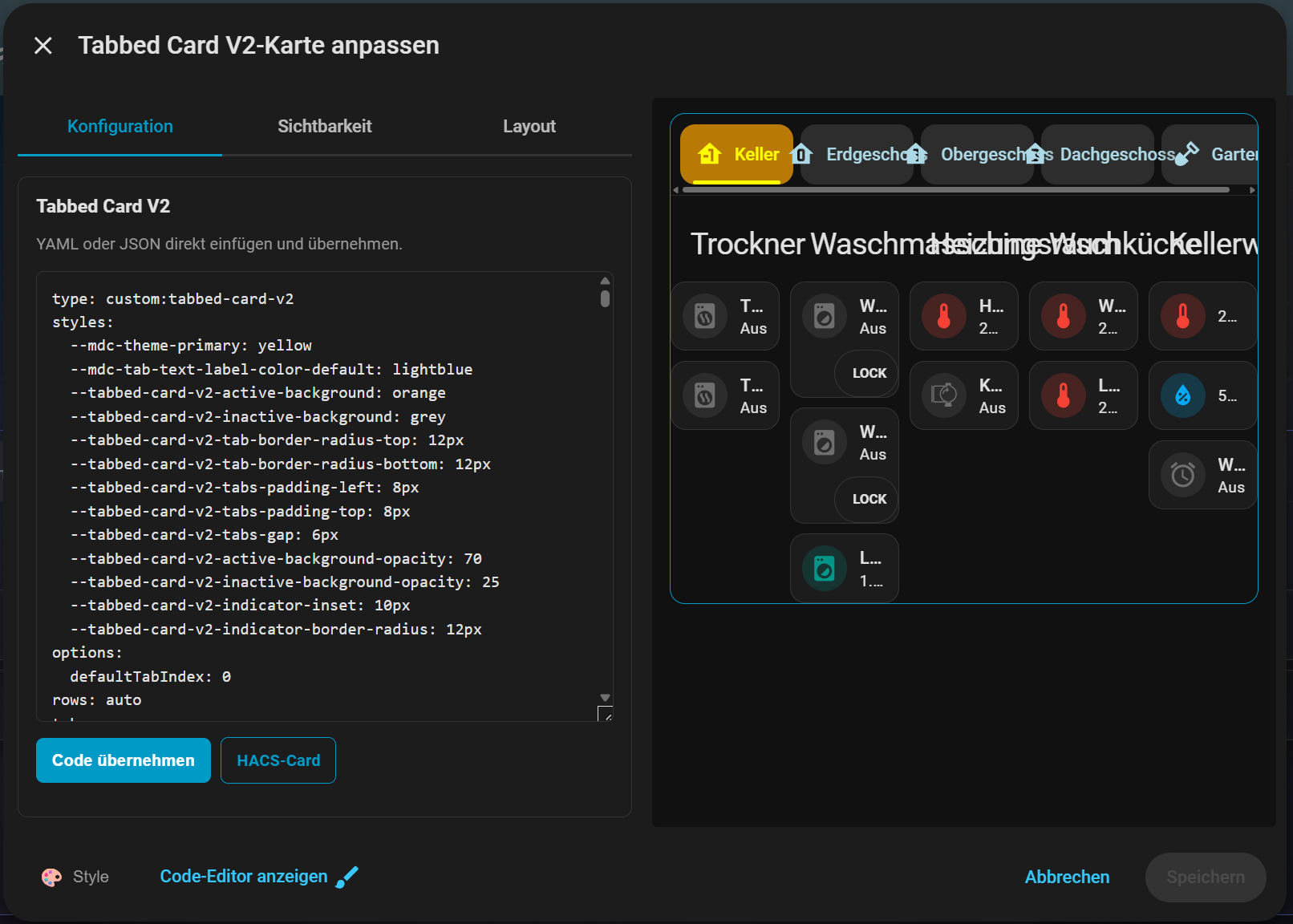

Example:
type: custom:tabbed-card-v2
styles:
  --mdc-theme-primary: "#ff9800"
  --mdc-tab-text-label-color-default: "rgba(255,255,255,0.75)"
  --tabbed-card-v2-card-background: "transparent"
  --tabbed-card-v2-card-border: "0.2px solid var(--primary-color)"
  --tabbed-card-v2-card-border-radius: "12px"
  --tabbed-card-v2-content-padding-side: "16px"
  --tabbed-card-v2-content-padding-bottom: "16px"
  --tabbed-card-v2-tabbar-background: "rgba(0,0,0,0.18)"
  --tabbed-card-v2-active-background: "#ff9800"
  --tabbed-card-v2-active-background-opacity: 35
  --tabbed-card-v2-inactive-background: "#ffffff"
  --tabbed-card-v2-inactive-background-opacity: 8
  --tabbed-card-v2-hover-background: "rgba(255,255,255,0.12)"
  --tabbed-card-v2-tab-border-radius-top: "12px"
  --tabbed-card-v2-tab-border-radius-bottom: "6px"
  --tabbed-card-v2-tabs-padding-left: "8px"
  --tabbed-card-v2-tabs-padding-top: "8px"
  --tabbed-card-v2-tabs-gap: "6px"
  --tabbed-card-v2-indicator-inset: "10px"
  --tabbed-card-v2-indicator-border-radius: "999px"
tabs:
  - attributes:
      label: Light
    card:
      type: button
entity: light.bed_lightCurrent Status
Native 0.1.317 update and combined project verified on Proxmox and Pi 5
Following fresh HA backups, both native updates and the nested Core/Bubble/ Mushroom project pass save/reopen, YAML/JSON, actual HACS re-import and byte-identical re-export with 112/112 package checks per host. Missing numeric Conditional bounds are rejected; above: -1, Jinja and CSS survive. Conditional rows hide at -2 and return at 18. Text, SVG icons and colors change live. 756 computed-CSS comparisons match native reference cards. Two light/dark switches per host preserve all 19 observed instances without reload. Editors reconnect automatically after ordered HA Core restarts; fresh Jinja updates work without reload. The Pi's brief intermediate connection state was not sampled; its subsequent connection and updates are verified. Scope: Chrome on the PC, HA 2026.10.1, Mushroom 5.2.3, existing UIX 8.4.0/Bubble 3.4.2 on Proxmox and separate temporary Card-Mod 4.2.1/Bubble 3.4.1 on Pi. Regular card views provide the CSS reference; HA panel views may override radii. Original local Editor states and default themes are restored; test files remain recoverable in Trash. Regenerate earlier exported scripts to include the correction.
Combined project qualification passes in isolation with 0.1.317
Conditional imports retain complete condition data, including numeric bounds such as above: -1 and below: 0, state lists and nested logical conditions, through YAML/JSON and HACS. Missing or invalid numeric bounds block import and package readiness with an explanation. The combined project passes save/reopen, actual HACS re-import with byte-identical re-export, dynamic Jinja text/icons/ colors, conditional hide/show, eight live theme transitions and 972 CSS comparisons. Both Editors reconnect without page reload after HA shutdown/start; fresh template updates work. Card-Mod 4.2.1 and UIX 8.4.0 are tested separately with HA 2026.10.1, Bubble 3.4.2 and Mushroom 5.2.3 in Chrome on the PC. Existing data is preserved; that isolated check left Pi 5 and Proxmox at 0.1.316. Previously lost bounds require the original source/backup; regenerate existing scripts. This is not a complete validator for every HA condition type.
Live theme switches verified on Proxmox and Pi 5 on 2026-10-17
After fresh HA backups, switches without reload also pass on both hosts with ATLAS 0.1.316 and HA 2026.10.1: Card-Mod 4.2.1 and UIX 8.4.0 separately, Mushroom 5.2.3, Bubble 3.4.2 on Proxmox or 3.4.1 on Pi. Twelve native/generated Core, Bubble and Mushroom cards per host/engine make seven custom/default theme transitions. 1,920 computed-CSS comparisons pass; document and Card instances remain unchanged. Inherited colors/radii follow the theme while fixed overrides remain intact. Fixture buttons use HA's native theme handler. Setup and engine changes are outside the measured sequences without reload. Original default themes and extension configuration are restored; existing files, projects and plugins remain intact. Native checks use passive sensors and Chrome on the PC, not an ARM64 browser benchmark.
Live theme switches qualified in isolation on 2026-10-17
With ATLAS 0.1.316 and HA 2026.10.1, mounted Core, Bubble and Mushroom cards switch between light and dark without reloading or rebuilding the cards. Card-Mod 4.2.1 and UIX 8.4.0 are tested separately with Bubble 3.4.2 and Mushroom 5.2.3: seven transitions per engine across custom/default themes, 960 computed-CSS comparisons in total. Inherited colors/radii change while explicit child overrides stay fixed. Native references and generated scripts match; document and Card identities remain stable throughout. Isolated fixture controls use HA's native theme handler; profile navigation and reload are outside the measurement sequence. Existing data, nine projects and original files remain intact. Pi 5 and Proxmox were neither queried nor changed. Other themes, browsers and versions need separate checks; this does not repeat the actual Editor/HACS UI roundtrip.
Bubble CSS and UIX inheritance fixed in 0.1.316
0.1.315 dropped Bubble CSS supplied as a string under styles: | on normal YAML/JSON import. 0.1.316 preserves the text, whitespace, newlines and empty strings through single/nested cards, HACS export and reimport. Existing styles objects remain supported.
Newly generated scripts use the native Home Assistant card wrapper for roots with uix/card_mod. UIX can then style a root stack without its own ha-card and its CSS variables reach child cards. Style blocks are neither flattened nor copied onto unrelated cards.
Isolated verification: HA 2026.10.1, Bubble 3.4.2, Mushroom 5.2.3, UIX 8.4.0. Core/Bubble/Mushroom match native references in light/dark and after reload (180 computed-CSS comparisons). Distinct green/purple parent accents now inherit correctly instead of falling back to a different color. Bubble overrides retain background, 3-px border and 9-px radius. Save/reopen and HACS UI reimport/re-export pass; 112/112 package checks and byte-identical ZIPs supplement the visible verification.
Existing Cards: after updating, export the original project again and replace the script together with its matching locales. Reimport previously lost Bubble CSS from the original YAML/JSON or a backup; the update cannot reconstruct discarded content. Stored projects/files are not rewritten automatically. After fresh HA backups, the 0.1.315 to 0.1.316 update also passes on Proxmox and Pi 5: six Core/Bubble/Mushroom cards per host with UIX 8.4.0, HA 2026.10.1, Mushroom 5.2.3 and Bubble 3.4.2 (Proxmox) or 3.4.1 (Pi). 240 computed-CSS comparisons including reload pass. YAML/JSON styles are preserved; HACS re-exports are byte-identical and each passes 112/112 package checks. Original complete local Editor configurations are restored. Native checks use the existing dark theme and passive sensors. Other HA/styling versions need separate checks. Isolated mounted-Card theme switches are documented above.
Native CSS qualification on Proxmox and Pi 5, 2026-10-17
After fresh HA backups and additional ATLAS file copies, Card-Mod 4.2.1 and UIX 8.4.0 were also tested separately on both real hosts: HA 2026.10.1, Mushroom 5.2.3, ATLAS App 0.1.315. Generated ATLAS scripts match native references for dynamic Jinja colors/borders, 3px shadow DOM spacing, background and radii. Colors change at natural minute boundaries without reload. Only passive sensors and separate test cards are used; no devices are controlled.
UIX applies the 17px radius and prefers uix when both blocks exist (37px instead of 31px). Card-Mod ignores uix. Neither engine applies the 7px padding in uix_style. Reload passes with both extensions. Existing browser scaling may round computed border widths to physical pixels; export and reference remain identical.
Switching engines requires HA restarts. Existing Proxmox UIX is re-enabled afterward; the additional Pi integration and separate test resources are removed after qualification; own test files remain in recoverable trash. Settings, original files, four existing ATLAS projects per host and six plugins are preserved. There is no new ATLAS release. This covers the named versions and rules, not arbitrary CSS or every theme.
CSS rendering checked in isolation, 2026-10-17
With App 0.1.315, HA 2026.10.1 and Mushroom 5.2.3, Card-Mod 4.2.1 and UIX 8.4.0 were tested in separate HA instances. Generated ATLAS scripts match the computed styles of equivalent native cards: Jinja color and a 4px border change blue → red → blue without reload; shadow DOM letter spacing is 3px. The UIX radius is 17px. A Core reference confirms background, a 6px border and a 23px radius. Reload and restart pass; unstyled cards sharing the entity remain unaffected. Pi 5 and Proxmox were not changed for this check.
Limits: imported uix_style data is preserved but has no CSS effect in these versions. Use uix: { style: ... } for UIX. When both card_mod and uix exist, UIX prefers uix; ATLAS does not merge them. Card-Mod does not execute uix. The UIX export choice converts structure, not CSS selectors or Jinja variables. The earlier fixture name “UIX legacy” was only a card label, not evidence of a supported alias.
Use config.entity in these extensions' CSS templates; Mushroom's own text/icon/color templates can use entity. mushroom-state-info$ does not match this Mushroom version. The tested selector is ha-tile-info$; internal DOM structures can change.
type: custom:mushroom-template-card
entity: input_boolean.your_test_entity
primary: "{{ 'On' if is_state(entity, 'on') else 'Off' }}"
card_mod: # Use uix: with UIX instead
  style:
    .: |
      ha-card {
        border: 4px solid {{ 'red' if is_state(config.entity, 'on') else 'blue' }};
      }
    ha-tile-info$: |
.info { letter-spacing: 3px; }Load Card-Mod as a frontend module. Install UIX as an integration, add it under Devices & services, then reload the page. Do not load both extensions: see UIX migration, UIX setup and Card-Mod. This covers the stated rules, not arbitrary CSS or every theme. Original templates and existing data are backed up; only separate fixture copies were adjusted. No ATLAS runtime code change was needed.
Native 0.1.315 update verified on Proxmox and Pi 5, 2026-10-17
After fresh HA backups, both hosts pass the 0.1.313 to 0.1.315 update and export/re-import checks: YAML/Card-Mod and JSON with UIX export each achieve 112/112 package checks and byte-identical re-export. Root and card styles, multiline CSS, shadow DOM selectors, Jinja and uix_style retain their exact ownership. Style objects in the generated script match package contents.
Existing settings, files, three previous server projects per host, six active plugins, trash and history are preserved. Complete local Editor configurations are restored exactly; new test projects remain separate. Direct Hub and embedded Runtime panel still show six active plugins. HA remains 2026.10.1 and the integration 0.1.306. No HA dashboards, resources or device tests were created. Arbitrary CSS execution by Card-Mod/UIX remains separate qualification against the installed styling extensions.
Imported Card-Mod/UIX styles from 0.1.315, checked in isolation on 2026-10-17
Imported card_mod, uix and uix_style objects remain on their own cards in the Editor, YAML/JSON, HACS package and generated script. Nested cards, multiline CSS, shadow DOM selectors and Jinja values survive. Cards sharing an entity do not receive each other's styles. YAML and JSON HACS roundtrips pass 112/112 checks and byte-identical re-export; direct JSON single-card import also passes in the browser.
The uix: export choice converts card_mod properties structurally to uix, including JSON and scripts. Existing uix/uix_style objects are preserved. If a card already has uix, both blocks are retained without overwriting or merging. card-mod preserves imported keys; it does not convert UIX back. This verifies data preservation, not arbitrary CSS execution in every Card-Mod/UIX version. Configure the required styling extension in HA.
Existing files, projects and plugins remain unchanged. Styles already discarded by older versions require re-importing the original file or a backup. That isolated check left Pi 5 and Proxmox untouched; the subsequent native qualification is documented separately above.
YAML/JSON HACS roundtrip from 0.1.314, checked in isolation on 2026-10-17
Choose YAML or JSON under Card format, export the HACS bundle, then import the complete .hacs.zip through Import HA card. Both formats pass the same 112 package checks. The selected format, Editor fields and Mushroom text, icon and color templates, including multiline values, survive; re-exporting produces identical bytes within each format.
The atlas/*.atlas-card.json envelope and locale files remain JSON; manifest.format describes the enclosed YAML or JSON card source. The generated script remains JavaScript. Existing valid YAML bundles need no conversion. The diagnostic code is now package-format-supported, replacing package-format-json. Malformed contents and missing locales are still rejected. The missing imported card_mod styles found in that test are fixed from 0.1.315, as described above. Pi 5 and Proxmox were untouched; their 0.1.314 update remains unqualified.
Mushroom import fix in 0.1.313, checked in isolation on 2026-10-17
Normal YAML/JSON imports preserve primary, secondary, icon, color and legacy icon_color for single and nested Mushroom Template Cards. Single cards retain their Mushroom type. Multiline YAML retains indentation and blank lines; malformed YAML is rejected.
Saving, reloading and HACS-bundle export/import retain the tested expressions. In HA 2026.10.1 with Mushroom 5.2.3, exported cards change their text, icons and colors with fixture states and reconnect automatically after a transport outage. HA evaluates Jinja; ATLAS preserves its source. Apply title deliberately replaces primary; changing the entity preserves the other templates. Values already lost through older imports require the original source to recover. Keep original YAML/JSON files.
This qualifies the named properties and fixtures, not arbitrary Mushroom options or Jinja programs. Legacy icon_color is checked for preservation; runtime tests use current color. No Jinja authoring controls are added. Existing data remains intact; the isolated correction check left Pi 5 and Proxmox unchanged.
Native 0.1.313 update verified on Proxmox and Pi 5, 2026-10-17
After fresh HA backups and PC file mirrors, all four import paths pass on both hosts: YAML/JSON, single cards and stacks. Text, icon and color templates retain their exact source, including blank lines. Save/open and actual HACS export/import pass; each re-export is byte-identical and JSON package readiness passes 112/112.
Real unsaved HA previews change text, icon glyphs and computed colors on natural Jinja minute boundaries without reload. Only passive sensor states are read; no devices are switched. Original 225/229 ATLAS files, two existing server projects per host, six plugins, settings, trash and history remain intact. Both complete local Editor configurations with 36 fields are restored exactly except for the export timestamp. Own test projects remain separate. Integration stays 0.1.306; this check requires no HA restart. This does not qualify arbitrary Mushroom options or Jinja programs.
Isolated 60-minute soak on 2026-10-17
ATLAS 0.1.312 with HA 2026.10.1 passed a full hour using 36 distinct local fixture entities: twelve Core, twelve Bubble and twelve Mushroom cards. 720 update batches made 10,080 successful service calls and requested 25,920 target updates without service failures. Both browser views reconnect automatically after 15-, 45- and 90-second transport outages without reloading during the hour. All fields/cards remain; all 36 final HA states match. Saving, reopening and actual browser export/import pass; both exports are byte-identical. Original fixture files, projects, plugin settings, trash and history remain intact. Full ATLAS process-group samples, starting during minute six, range from 168.1 to 168.6 MiB; HA container samples over the hour range from 652 to 681 MiB. Chrome was measured globally, including other tabs; these results do not establish per-card browser memory usage. The hour uses a generated fixture package; the actual browser export is compared separately afterwards. Authored dynamic Mushroom Jinja text, ARM64 performance and production capacity remain outside this check. Pi 5 and Proxmox were neither queried nor changed.
Native 36-card workflow on Proxmox and Pi 5 on 2026-10-16
After fresh HA backups, ATLAS 0.1.312 and HA 2026.10.1 passed twelve Core, twelve Bubble and twelve Mushroom cards on each host. Saving, reloading, reopening and importing the actual browser export retain all 36 fields and the card configuration. Both exports per host are byte-identical with the same EN/DE/FR selection. Original local Editor configurations were restored and compared in full afterwards. Following a real Proxmox VM reboot and a user-performed Pi LAN interruption, the existing Editors reconnect without reload; the HA views still show all 36 cards without error cards. This host check uses passive existing sensors, without the isolated test's 360 synthetic state changes. Chrome on the PC renders the cards; this is not an ARM64 browser or CPU/RAM benchmark. Existing ATLAS files, projects, plugins, trash and history remain intact. A changed HACS query parameter on the existing selfhst resource was separately observed after the VM reboot and retained.
Larger project qualified in isolation on 2026-10-16
ATLAS 0.1.312 and HA 2026.10.1 passed a 36-field Expert project: twelve each of Core, Bubble and Mushroom cards using two local fixture entities. Saving, reloading and opening the server project, plus HACS-bundle export/import, retain all fields and card configuration. Repeated exports with identical language options are byte-identical. HA renders all 36 cards without error cards. During 360 state changes over just above three minutes, the Editor and, for the longest outage, the HA view reconnect automatically after transport outages of about 12, 24 and 62 seconds. Existing fixture data remains intact. Pi 5 and Proxmox were neither queried nor changed. This is a bounded functional test, not a hardware benchmark or proof of arbitrary project sizes. The actual browser export was checked as a complete package at a fresh resource path. Manual replacement at the same URL may mix a cached old script with new locale files and trigger the repair notice.
The Card Editor is in active development. Expert workflow, import/export, entity selection, resource checks, container cards and local custom-card mappings for scanned Lovelace resources are already testable. Additional reviewed custom-card mappings will be added step by step.